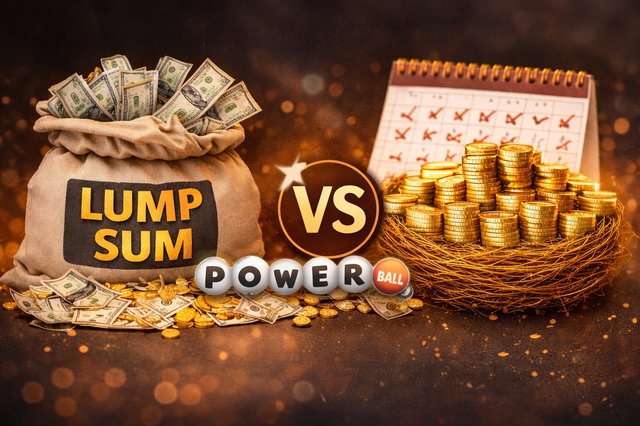
When a player hits the jackpot in the Powerball, one of the biggest decisions isn’t which numbers to pick — it’s how to get paid.
Powerball winners have two payout options:
-
Lump Sum
-
Annuity
Each has advantages and trade-offs — and the choice can affect how much money you actually walk away with.
Let’s break down the differences, how they affect total payout, and which tends to be more lucrative after taxes and inflation.
What Is the Powerball lottery Lump Sum?
The lump sum is:
-
One single payment
-
Paid soon after claiming
-
Equal to the cash value of the jackpot
This is less than the advertised jackpot total because the jackpot is funded by ticket sales over time.
How It Works
When you choose lump sum:
-
You receive the entire amount immediately
-
You can invest, spend, or save as you wish
-
You pay taxes up front
In most cases, the lump sum is 40–60% of the advertised jackpot.
What Is the Powerball lottery Annuity?
The annuity option:
-
Pays the full advertised jackpot
-
Paid in 30 graduated annual payments
-
Each payment increases by ~5% over the previous year
This structure is designed to maintain value against inflation and ensure winners receive the full statistical jackpot amount.
How It Works
-
Year 1: smallest payment
-
Year 30: largest payment
-
Payments increase over time
This smoothed schedule equals the full jackpot total if you collect every payment.
Lump Sum vs Annuity — Which Pays More?
Basic comparison:
| Option | Total Paid Before Taxes | Paid All at Once? | Affects Inflation? |
|---|---|---|---|
| Lump Sum | Lower (cash value) | Yes | Winner controls it |
| Annuity | Full jackpot | No | Partially protected by growth |
On paper, annuity pays more total dollars — because it equals the entire advertised jackpot.
But is more always better? Not necessarily.
How much of your Powerball lottery winnings you actually receive – after taxes?
Taxes change everything.
In the U.S.:
Federal withholding alone can take 24–37% of winnings.
State taxes may reduce payouts further.
So real take-home amounts might look like:
-
Lump Sum after taxes: Significantly less than gross value
-
Annuity after taxes: Spread out, but still reduced each year
In many cases, after tax, the difference between lump and annuity shrinks.
What to consider that affect total value of your Powerball lottery winnings?
Your Financial Goals
-
Immediate cash needs?
-
Do you want to invest?
-
Plan for family inheritance?
Investment Opportunities
If you take the lump sum and invest wisely, you might grow your net wealth more than the annuity provides over time.
On the other hand, annuity payments protect winners from:
-
Bad investment decisions
-
Spending too quickly
Inflation & Market Risk
Inflation erodes the value of future annuity payments.
High market returns could make lump sum more valuable in real terms.
Example: $500 Million Powerball lottery Jackpot (Hypothetical)
| Option | Amount Before Taxes | Estimated After 30% Tax |
|---|---|---|
| Lump Sum | ~$300M | ~$210M |
| Annuity Total | $500M over 30 years | ~$350M+ (after spread taxation)* |
*Tax on annuity payments applies as each payment is received.
In this example, annuity still pays more total dollars, but:
-
You get it over decades
-
Present value may be lower
So Which Option Is Better for Powerball lottery winners – Lump Sum or Annuity?
There’s no one answer. It depends on:
-
Your financial discipline
-
Investment strategy
-
Age and health
-
Tax planning and advisors
Quick Summary
-
Annuity: Pays more in total dollars, spread over 30 years.
-
Lump Sum: Smaller upfront amount, but immediate access and investment control.
-
Taxes: Reduce both options significantly.
-
Value: Real value depends on inflation and investment decisions.
Do you want to play Powerball lottery?
Understanding payouts is just part of the journey. If you’re ready to get in the game, you can buy Powerball tickets online through official ticket services and be part of the next drawing.
Learn how to buy Powerball tickets online safely and securely.